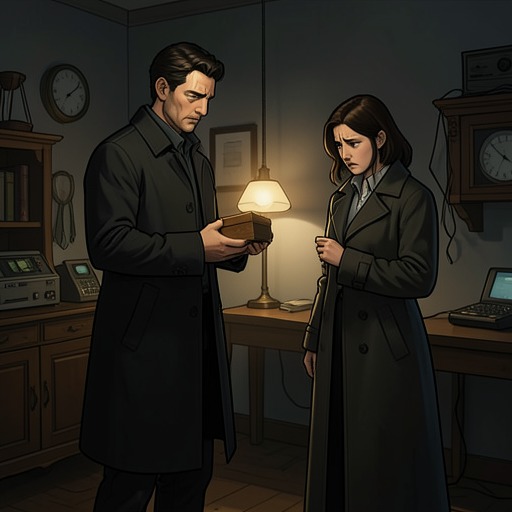
Humboldt’s blackmail attempt against Victoria Warshawski and Dr. Herschel
Blood ShotGustav Humboldt’s attempt to obtain Dr. Chigwell’s notebooks becomes a direct test of whether money and threats can make V. I. Warshawski and Dr. Lotty Herschel surrender evidence about the Xerxes employees. Humboldt offers Warshawski relief from her mortgage and a substantial stock bonus, while holding out the possibility of damaging Herschel through a patient’s accusation. Warshawski refuses: the notebooks have already been sent to an attorney and medical specialists, and neither the offered rewards nor the threats change that fact.
The notebooks and the leverage
Humboldt presents the notebooks as both useless and dangerous. He says he has only recently learned that Dr. Chigwell kept records about Xerxes employees without his knowledge, and dismisses their contents as inaccurate. Yet he fears that, in other hands, the records could appear damaging to the company, particularly because they span many years and might be difficult to discredit. The contradiction exposes the real purpose of his offer: he does not need to believe the notebooks are reliable to fear what they could reveal or what their existence could support.
The notebooks’ long time span makes the dispute more than a quarrel over an isolated medical record. Warshawski points out that a twenty-year record would be difficult to explain away if challenged. The company’s exposure is also presented as potentially immense: she tells Humboldt that claims related to Xerxine could eventually reach half a billion dollars and argues that malicious intent could be established. This is Warshawski’s assessment during the confrontation, not a final legal finding, but it shows why Humboldt seeks control of the material before it can be examined by others.
A bargain framed as generosity
Humboldt constructs his approach as a series of benefits. He raises Warshawski’s mortgage, offers to remove the threat to Herschel’s license, and suggests that she could receive enough money to pay off the debt and buy a more suitable car. He has researched her circumstances closely enough to turn the offer into a tailored appeal. The personal details are meant to make the pressure seem practical and even considerate, while shifting attention away from the underlying exchange: Warshawski is to retrieve records concerning Xerxes employees.
The financial inducement becomes more concrete when Humboldt presents a document representing two thousand preferred shares in Humboldt Chemical. Warshawski calculates their value at two hundred thousand dollars, without brokerage fees. She acknowledges that the amount is significant but says she could make more by shorting the company if money were her priority. Her refusal is not simply a rejection of an inadequate price; it establishes that the evidence and the people it concerns cannot be traded for personal financial security. She also makes clear that Humboldt is too late: the notebooks have already gone to an attorney and a team of medical specialists.
Threatening Herschel through Mrs. Portis
When the financial proposal fails, Humboldt introduces Mrs. Portis, whose daughter had once been a patient of Herschel’s. Mrs. Portis recounts her distress after the appointment and indicates that she went to the state’s attorney with a report. Humboldt uses her presence to make the danger to Herschel specific, threatening her professional standing through an allegation involving the child. Warshawski understands that the accusation is being deployed as leverage to force the notebooks’ return, rather than as a separate matter raised in good faith.
Warshawski contacts Herschel and explains the proposed exchange: her license against the notebooks, alongside the mortgage and the stock offer. Herschel does not ask Warshawski to decide for her. Instead, she says that she will speak to Humboldt herself and rejects the premise that fear should dictate her response. Their exchange makes Herschel an active participant in resisting the coercion, not merely its threatened target. Humboldt ends the call after objecting to Herschel’s response and warns that both women will regret their refusal, invoking his power in the city.
Refusal and consequences
Warshawski answers Humboldt’s threats by pointing to the consequences she believes are already gathering around him. She says the Herald-Star is investigating his connection to Steve Dresberg and predicts that the Xerxine claims will put the company under severe pressure. She also invokes the evidence now outside Humboldt’s control: because the notebooks are with legal and medical reviewers, his offer can no longer secure their return. His effort to present himself as powerful thus meets a different kind of power—the independent examination and potential circulation of records he had hoped to contain.
Humboldt continues escalating his threats, extending them beyond Warshawski and Herschel to other people identified through his researchers. Warshawski keeps Peppy close, signals for assistance, and, when the butler returns, asks him to arrange a cab for Mrs. Portis. She leaves with the dog rather than prolonging the confrontation. The scene ends without Humboldt obtaining the notebooks or securing either woman’s compliance.
In the aftermath, Warshawski and Herschel consult their lawyer, Carter Freeman. Mrs. Portis loses interest in bringing charges against Herschel; the account leaves open whether this followed Freeman’s work, the encounter at the Roanoke, or both. Warshawski’s mortgage remains a problem for several weeks, but Freeman eventually arranges a settlement. Warshawski suspects that he personally guaranteed it, although he does not confirm this. The attempt therefore has practical consequences even after the immediate threat recedes: the mortgage is unsettled for a time, but the accusation does not proceed, and the notebooks remain beyond Humboldt’s reach.